
- The media and entertainment sector today stands at the third major wave of disruption, powered by artificial intelligence, following the internet and streaming revolutions.
- Internet started in 1970s but majorly emerged in 1990s. Today , Global Internet has 5.64 billion internet users globally . As of 2024, there are 954.40 million(95 crore. 44 lakhs) internet subscribers in India.
- In 2000s streaming services started and today alone in India 700 million(70 crore) users are engaged with some form of streaming platform.
- Netflix, Amazon Prime, Hotstart etc are some of the biggest player.
- These data show that the ecosystem for starting a winning media company is already at place.
- However the new emerging Technology AI is now again bringing paradigm shift in media and entertainment India.
- Earlier revolution were more focused on users and how they can better engage with the content either in Video Audio and Text form.
- But Emergence of AI tools like Veo 3 , Gemini etc has changed the game where the content itself is now getting creating with lesser human interventions.
- In such transforming time, how one can take leverage the transformation due to new changing agent and create a billion dollar media company.
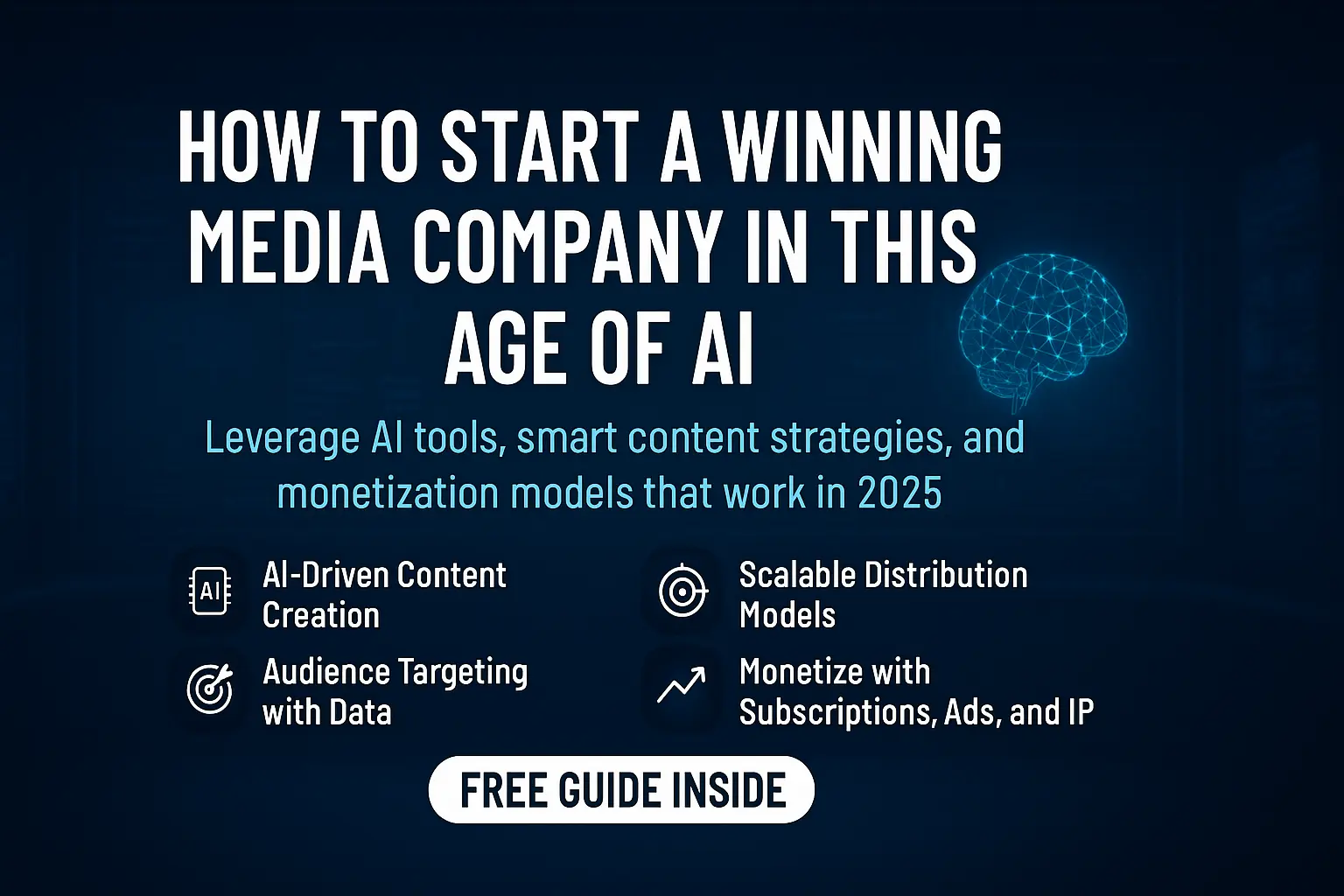
How to start a winning media company in this age of AI ?
- To start a winning media company in this age where AI is distrusting every industry and succeed against conventional players, it is crucial to understand the evolving landscape, strategically adopt AI, and focus on building deep, direct audience relationships.
Understanding the Evolving Media Landscape
- The traditional business models of media are under threat, with major studios experiencing revenue decreases.
- EY report (June 2025): The Indian film sector saw revenue drop by 5% to ₹187 billion in 2024, with theatrical admissions falling. Digital and satellite rights values also slipped roughly 10%, indicating weaker demand for conventional distribution channels. {Ernst and Young}
- The industry is witnessing a significant shift from conventional media like television and print towards digital media, which has become the largest segment, redefining content creation, distribution, and monetization.
- A key aspect of this shift is the rise of individual content creators and YouTubers, who are increasingly disrupting traditional media roles.
- Modern consumers exhibit reduced attention spans, demanding more engaging content delivered in shorter formats.
- Audiences are also more vocal and demanding, actively consuming and providing feedback.
- This environment leads to a new reality where “everyone is a media company” or a “content creator,” making it harder to build a distinct brand and stand out amidst the increased noise.
Leveraging AI for a Competitive Edge
- Artificial intelligence is not just a tool but a transformational force that can enable higher efficiency, better content, and improved decision-making for media companies.
- The media and entertainment industry has been an early adopter of AI, embracing it to enhance content creation, user experience, and brand presence.
Key areas where AI adoption can provide a significant advantage include:
• Increased Efficiency and Enhanced Production: AI enables faster and leaner business processes and content production workflows.
- For instance, it can improve the accurate indexing of film assets, reducing search time, and processes from contract to invoice can see major gains.
- On the creative side, generative AI can take line producers 70% of the way from script to pre-visualization, turning a week’s work into hours, allowing creatives to focus on imaginative tasks.
• Content Enhancement and Personalization:
- AI tools like Flawless AI TrueSync can perform seamless dubbing with conversion of mouth movements and facial gestures.
- It plays a crucial role in content personalization, offering tailor-made suggestions on OTT platforms to retain customers and improve their experience.
- AI also enables individually targeted advertising on streaming platforms, eliminating irrelevant ads and increasing profit margins.
- Furthermore, it allows for adaptive streaming quality based on users’ data speeds to prevent buffering.
• Improved Decision Making:
- AI supports better greenlighting and production decisions through AI-enabled content strategy analytics.
- It can also aid in making more inclusive casting decisions based on viewership analytics.
• Content Management and Security:
- AI tools assist in adhering to regulatory guidelines for online content distribution through automated content moderation and can detect bogus content or copyright violations, protecting consumers and creators alike.
- AI also automates content categorization and classification by tagging and annotating metadata, which is essential for content personalization.
• Evolving Journalism:
- For journalists, AI serves as a “great tool,” reducing research time and allowing them to focus on creating more insightful and thought-provoking stories.
- The shift from “production work” to an era where humans can focus on “creativity, empathy, and leadership” is being driven by AI.
- Despite the known risks, such as biased AI output from incomplete inputs, the spread of misinformation if AI-generated content isn’t transparently disclosed, and intellectual property (IP) issues arising from generative AI, the industry consensus is that these risks do not justify holding back on AI innovation. Those who do not experiment with AI now will fall behind.
Strategies for a Winning Media Company
- Beyond AI adoption, building a winning media company in this disrupted environment requires a multi-faceted approach:
- Community First Media: In an increasingly fragmented information space, building strong, direct relationships with your audience is paramount.
- This involves fostering a community where people can connect, rather than just passively consume content.
- Events, both online and offline, are crucial for creating tangible connections and building loyalty that goes beyond purely digital interactions.
- Events like TechSparks have proven to be successful properties for engaging communities and generating revenue.
- Diversified Monetization Models: Relying solely on advertising or broad subscriptions is challenging, especially in markets like India where paying for content is less common. Winning companies must innovate on revenue:
- –B2B Services: Offer research, roundtables, branded content series, or educational series that provide value to businesses interested in your audience.
- Events as a Core Revenue Stream: Beyond content, events can become a major part of the economic model, functioning as a “front business” where publishing generates leads and relationships that convert into revenue streams.
- Niche Subscriptions/Memberships: While broad subscriptions are tough, highly specialized, high-value content for a specific audience (e.g., in finance or tech) might work. The idea of tokenized, frictionless payments for high-value content could also be explored.
- Moreover, memberships tied to a network or community (e.g., an “Elite Card” for access to exclusive events and co-working spaces) could offer a viable subscription model by fulfilling the human desire to meet and network with relevant individuals.
- Podcasts as “Top of Funnel”: While directly monetizing niche podcasts can be difficult, they are highly effective at building human connection and can serve as a powerful tool to drive engagement towards high-value, in-person events.
- Owning Your Platform and Consistency: Instead of being at the mercy of large platforms, a winning company should aim to build its own platform (e.g., using open-source models like Ghost over Substack) to have more flexibility, control over data, and the ability to build custom features.
- Consistency and stamina in content creation are crucial, as it takes time to build a brand and attract an audience.
- Strategic Niche and Authenticity: While finding a unique content gap is increasingly challenging due to the proliferation of creators, a strong brand still needs to stand out with high production quality and engaging experiences.
- Maintaining authenticity and building genuine connections is vital.
- Journalists, in particular, should embrace curiosity and the ability to connect the dots in a noisy information environment, rather than just breaking news.
- Collaboration Over Competition: Instead of viewing traditional media and new creators as competitors, there’s a strong argument for collaboration.
- Both sides can benefit: new creators gain credibility and reach from established brands, while old media gains access to new audiences and contemporary content styles.
- Embracing a Smaller, Focused Model: The future of media may not be about massive conglomerates but rather numerous smaller, highly successful media businesses.
- These niche players, focused on specific valuable audiences, can thrive by understanding their community deeply and providing targeted value, potentially avoiding the challenges faced by mass media in the digital age.
- In conclusion, starting a winning media company in the age of AI requires agility, innovation, and a fundamental shift towards audience-centric models.
- By strategically adopting AI for efficiency and personalization, diversifying revenue streams with a strong emphasis on community and events, owning one’s platform, and maintaining authenticity in a highly fragmented space, new media companies can carve out a successful path and challenge conventional media.
- Experimentation and a willingness to adapt are key to navigating this ongoing transformation
Business Idea : AI OTT Streaming Platform
Elaboration of the Business Idea
- The business idea revolves around launching an AI OTT (Over-The-Top) Streaming Platform, tentatively named “AIStream,” as a dedicated hub for AI-generated content.
- This addresses the growing restrictions on mainstream platforms like YouTube, which, as of July 15, 2025, has updated policies to demonetize “mass-produced” or “repetitive” AI-generated videos (often called “AI slop”) to prioritize authentic human content more Similarly, platforms like Facebook are implementing guidelines to curb AI content monetization, creating a niche for a specialized service.
Key Features:
- Content Creation: Users upload or generate content via integrated AI tools (e.g., text-to-video, script generation using models like Grok or similar APIs). Categories include AI-made movies, tutorials, music videos, news summaries, and interactive stories.
- User Experience: Ad-free premium subscriptions, personalized recommendations powered by AI algorithms, community voting on content quality, and creator tools for collaboration between humans and AI.
- Target Audience: AI enthusiasts, content creators frustrated with mainstream restrictions, educators, businesses for automated marketing videos, and casual viewers seeking innovative, endless content streams.
- Differentiation: Unlike YouTube’s crackdown on AI spam, this platform celebrates and monetizes it through fair revenue sharing (e.g., 70% to creators), blockchain-based ownership verification, and ethical AI guidelines to avoid misinformation.
- Market Opportunity: With AI content proliferating but facing backlash, the global OTT market (projected at $300B+ by 2025) has a void for AI-specific streaming. It taps into the rise of generative AI, where creators need a safe space without labeling or demonetization risks.
- Challenges: Ensuring content quality to avoid “slop,” legal issues around AI copyrights, competition from emerging AI tools, and building trust amid AI skepticism.
- Growth Potential: Start with web/app access, expand to smart TVs, partner with AI companies for exclusive content, and use viral marketing on X (formerly Twitter) to attract displaced creators.
This platform positions itself as the “YouTube for AI,” fostering innovation in a censored space.
Business Plan
- Executive Summary: AIStream is an OTT platform exclusively for AI-generated content, capitalizing on YouTube’s 2025 AI monetization crackdown to fill a market gap.
- Market Analysis: Target 50M+ AI users; OTT industry grows 15% annually. Competitors: None specialized; opportunity in discouraged AI niches.
- Product: AI tools for creation/upload; categories like films, education; freemium model with ads/subscriptions ($4.99/month).
- Revenue Model: 60% from subs/ads, 30% creator fees, 10% partnerships. Initial costs: $2M (tech/dev/marketing); break-even in 18 months at 500K users.
- Marketing Strategy: Social media campaigns, AI influencer partnerships, SEO for “AI videos.”
- Operations: 10-person team; scale via cloud infrastructure.
- Risks & Exit: IP disputes; aim for acquisition by tech giants. Projected 5-year revenue: $50M.





Leave a Reply